Knowing What Success Looks Like
At St. Francis College, we believe that students achieve their best when they understand not only what they are learning, but also what successful learning looks like.
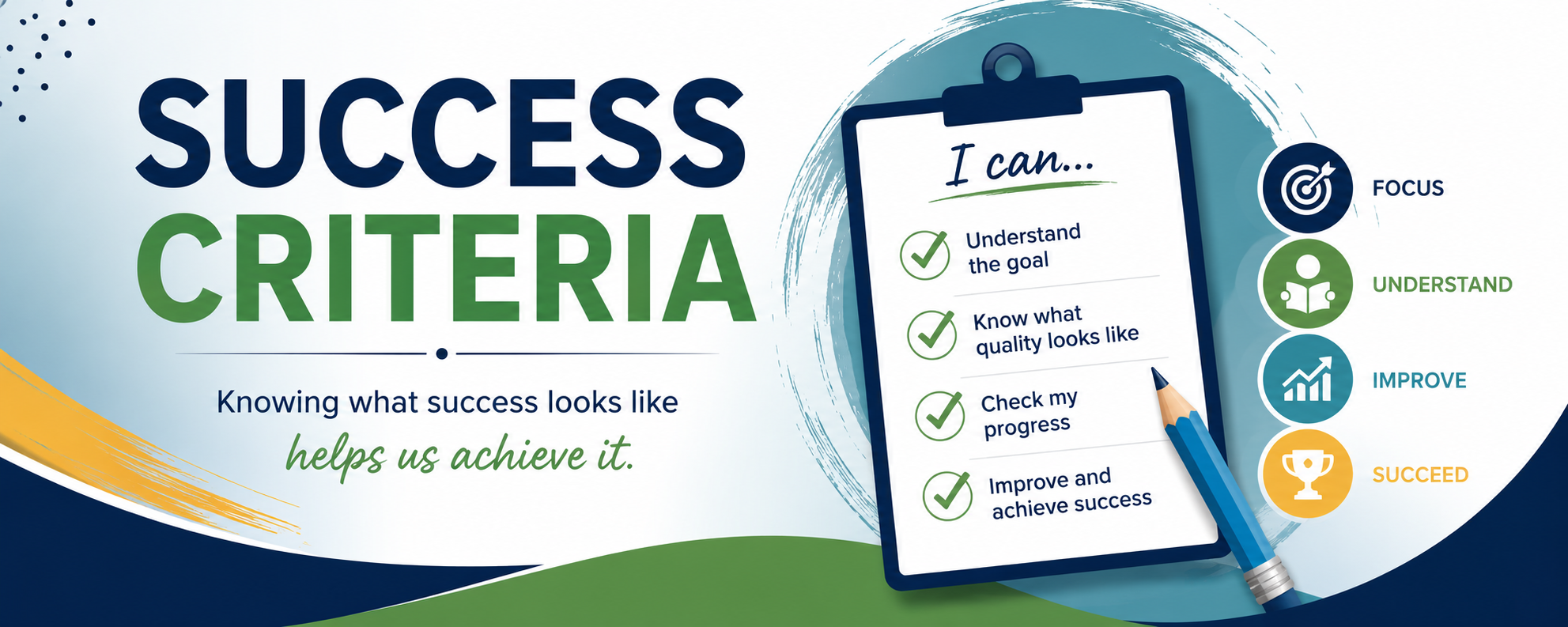
Success Criteria make learning visible. They help students understand the steps needed to achieve the Learning Intention, giving them confidence, direction and ownership of their learning.
Success Criteria are an important part of effective teaching and learning and are promoted throughout Irish education through the work of the Department of Education, National Council for Curriculum and Assessment (NCCA), and the Inspectorate as key features of high-quality classroom practice.
What are Success Criteria?
Success Criteria are clear statements that describe what students need to do, demonstrate or produce to show that they have successfully achieved the Learning Intention.
They answer the question:
"How will I know if I have been successful?"
For example:
Learning Intention
To write a persuasive paragraph.
Success Criteria
✔ I have a clear opening statement.
✔ I include at least three persuasive reasons.
✔ I support my ideas with evidence or examples.
✔ I use persuasive language.
✔ I finish with a strong concluding sentence.
Students can use these criteria during the lesson to guide their work and afterwards to evaluate their progress.
Why are Success Criteria Important?
Success Criteria help create classrooms where expectations are clear and learning is purposeful.
They:
make learning goals visible
reduce uncertainty
help students become more independent learners
encourage self-assessment and reflection
support meaningful feedback
improve confidence and motivation
focus attention on improvement rather than simply completing tasks.
Rather than wondering if their work is "good enough", students know exactly what they are aiming for.
For Our Students
Success Criteria help students to:
Understand Expectations
Students know exactly what quality work looks like.
Monitor Their Own Progress
They can regularly check:
"Have I done everything needed?"
Receive Better Feedback
Teachers can give specific advice linked directly to the Success Criteria.
Improve Over Time
Students learn that success is achieved through improvement, reflection and effort—not simply by getting answers right first time.
For Parents
Success Criteria provide greater transparency about classroom learning.
Parents can better understand:
what their son is learning
what quality work looks like
how teachers assess learning
how they can support learning at home.
Instead of asking,
"Did you finish your homework?"
Parents can ask,
"Which Success Criteria were you working towards today?"
This encourages richer conversations about learning rather than simply task completion.
For Teachers
Success Criteria are an important element of high-quality teaching.
They support teachers by:
making learning expectations explicit
planning lessons around clear outcomes
providing a shared language of learning
supporting formative assessment
enabling effective questioning
making feedback more focused
helping students take greater responsibility for their learning.
When Success Criteria are referred to throughout a lesson, students become active participants in evaluating their own progress.
Success Criteria and Assessment for Learning
Success Criteria are closely linked to Assessment for Learning (AfL).
They enable students to:
assess their own work
provide constructive peer feedback
identify next steps for improvement
celebrate progress.
This develops independent learners who understand how learning happens, rather than simply completing tasks.
Success Criteria and School Self-Evaluation (SSE)
At St. Francis College, Success Criteria also support our ongoing commitment to School Self-Evaluation (SSE).
By embedding Success Criteria consistently across classrooms, we aim to:
improve the quality of teaching and learning
develop consistent classroom practice
strengthen Assessment for Learning strategies
increase student engagement
promote student voice
encourage reflective teaching practice
support continuous school improvement.
As part of our SSE process, we regularly reflect on how effectively Learning Intentions and Success Criteria are being used to improve outcomes for all learners.
What You Might See in Our Classrooms
Visitors to our classrooms may observe:
Learning Intentions shared at the beginning of lessons
Success Criteria displayed and discussed
Teachers referring back to the criteria during learning
Students checking their own work against the criteria
Peer assessment using agreed Success Criteria
Feedback linked directly to the Success Criteria
Reflection at the end of lessons on how well the criteria have been achieved.
These practices help make learning visible, purposeful and focused on continuous improvement.
Our Philosophy
Every student deserves to know what success looks like.
At St. Francis College, Success Criteria help create classrooms where expectations are clear, learning is meaningful, and every student is supported to achieve their full potential. By making success explicit, we foster confident, reflective learners who understand not only what they are learning, but how to improve. This commitment underpins excellent teaching, supports our School Self-Evaluation journey, and reflects our belief that every learner can succeed with clarity, guidance and high expectations.